

The manufacturing landscape is undergoing a profound transformation, driven by the convergence of automation, digitalization and intelligent systems.
Among the most visible and impactful of these changes is the rapid advancement of robotics—particularly in the domain of machine tending.
Once limited to high-volume automotive lines, robotic machine tending has now permeated a wide range of industries, from precision engineering and metal cutting to electronics, plastics and even small-batch manufacturing. Today’s robots are faster, smarter, safer and more adaptable than ever before, making them an indispensable asset for modern factories.
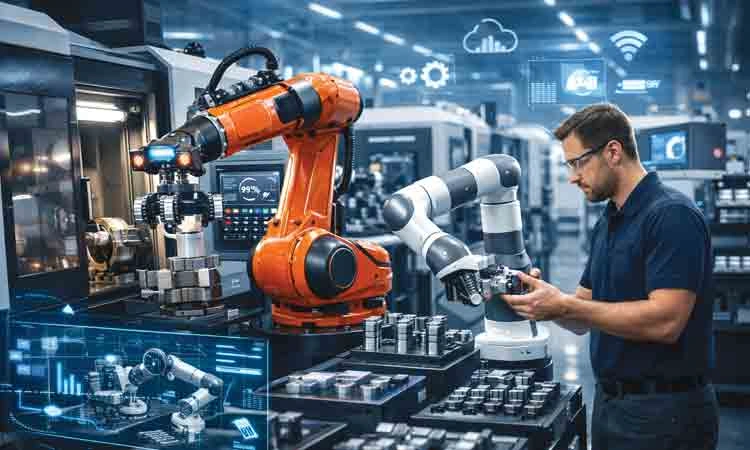
At its core, machine tending involves the loading, unloading, handling and transfer of parts between machines such as CNC machining centres, turning machines, presses, injection moulding machines and inspection systems. Traditionally performed manually, these repetitive and often hazardous tasks are now increasingly entrusted to robots, delivering gains in productivity, consistency and workplace safety.
From Basic Automation to Intelligent Robotics
Early machine-tending robots were largely programmed for simple, repetitive motions, operating in fenced environments with minimal interaction with human operators. While effective, they lacked flexibility and required significant engineering effort to deploy. The latest generation of robots, however, represents a quantum leap forward.
Modern industrial robots are equipped with advanced controllers, high-precision servo drives and sophisticated software that enable smoother motion, higher payload-to-weight ratios and improved repeatability. More importantly, the integration of sensors, vision systems and AI-driven algorithms has transformed robots from mere executors of commands into intelligent collaborators capable of perception, decision-making and adaptation.
This shift has made robotic machine tending viable not only for mass production but also for high-mix, low-volume manufacturing, a segment traditionally resistant to automation.
Collaborative Robots: Democratizing Machine Tending
One of the most significant developments in recent years has been the rise of collaborative robots, or cobots. Designed to work safely alongside humans without extensive safety fencing, cobots have lowered the barriers to robotic adoption, particularly for small and medium enterprises (SMEs).
Cobots feature force and torque sensing, rounded edges, lightweight construction and built-in safety functions that allow them to stop instantly upon contact.
This enables close human–robot interaction, where operators can load fixtures, inspect parts or perform secondary operations while the robot handles routine machine tending tasks.Ease of programming is another major advantage. Graphical user interfaces, hand-guiding and no-code or low-code programming platforms allow operators with minimal robotics expertise to deploy & reconfigure cobots quickly.
This flexibility is especially valuable in job shops where frequent changeovers are the norm.
Vision-Guided Robotics: Enhancing Flexibility
Machine vision has become a cornerstone of advanced machine-tending solutions. Vision-guided robots use 2D and 3D cameras to identify part orientation, position and geometry in real time. This eliminates the need for precise part placement using fixtures, trays or pallets. With vision systems, robots can pick randomly oriented parts from bins, adapt to variations in component shape and compensate for positional inaccuracies. This capability significantly enhances system flexibility while reducing tooling costs and setup times.
In machine tending, vision also plays a vital role in quality assurance. Robots equipped with vision sensors can inspect parts for defects, verify dimensions, check surface finish and ensure correct orientation before loading or after unloading from the machine. This integration of handling and inspection helps manufacturers achieve higher quality consistency and traceability.
AI and Machine Learning: Toward Autonomous Operations
Artificial intelligence and machine learning are increasingly being embedded into robotic systems, pushing machine tending toward greater autonomy. AI-enabled robots can analyze process data, recognize patterns and continuously improve performance.
For example, by learning from cycle time variations, tool wear patterns or machine alarms, robots can adjust handling speeds, modify sequences or alert operators before issues escalate. In advanced setups, robots can dynamically prioritize tasks, balance workloads across multiple machines and optimize throughput without human intervention.
AI also enhances predictive maintenance. By monitoring motor currents, vibration signatures and operational anomalies, robotic systems can predict component wear and schedule maintenance proactively, reducing unplanned downtime.
Multi-Machine Tending and Cell-Based Automation
Another key trend is the move from single-machine automation to multi-machine tending cells. Instead of dedicating one robot per machine, manufacturers are deploying robots that tend multiple machines arranged in a cell or line.
These cells often include CNC machines, washing stations, marking systems, coordinate measuring machines (CMMs) and palletizing units. A single robot, guided by intelligent scheduling software, can manage part flow across the entire cell, maximizing equipment utilization and minimizing idle time.
Such integrated automation cells are particularly attractive in space-constrained facilities, as they deliver high productivity per square metre while maintaining flexibility.
Digital Integration and Industry 4.0
Advances in robotics and machine tending are closely aligned with the principles of Industry 4.0. Robots today are no longer standalone entities; they are connected assets within a digital manufacturing ecosystem.
Through IIoT connectivity, robotic systems communicate with CNC machines, MES, ERP and quality systems, enabling real-time data exchange and centralized monitoring. Manufacturers gain visibility into robot utilization, cycle times, downtime reasons and production metrics, supporting data-driven decision-making.
Digital twins—virtual replicas of robotic cells—are increasingly used for simulation, offline programming and optimization. By testing layouts, cycle sequences and robot paths in a virtual environment, manufacturers can reduce commissioning time, avoid collisions and accelerate time to production.
Addressing Workforce Challenges
One of the most compelling drivers for robotic machine tending is the growing challenge of skilled labour shortages. Manufacturing industries worldwide are struggling to attract and retain operators willing to perform repetitive, physically demanding or monotonous tasks.
Robots help bridge this gap by taking over routine operations, allowing human workers to focus on higher-value activities such as process optimization, quality improvement, programming and supervision. Far from replacing jobs, robotic machine tending is reshaping roles, demanding new skills in automation, data analysis and system integration.
Forward-looking manufacturers are investing in training and upskilling programs to prepare their workforce for this collaborative human–robot future.
Safety, Reliability and Compliance
Advances in safety standards and certifications have further accelerated the adoption of robotic machine tending. Integrated safety PLCs, laser scanners, light curtains and safe motion functions ensure that robots operate reliably within defined parameters.
Modern systems comply with international safety standards, enabling seamless integration into regulated manufacturing environments such as automotive, aerospace and medical device production.
The Road Ahead
As robotics technology continues to evolve, machine tending solutions will become even more intelligent, autonomous and accessible. The convergence of AI, edge computing, advanced sensing and cloud connectivity will enable self-optimizing robotic cells capable of responding to changing production demands in real time.
In the near future, we can expect robots that learn new tasks through demonstration, reconfigure themselves autonomously and collaborate seamlessly with humans and other machines.
Machine tending will no longer be viewed as a discrete automation task but as an integral part of a connected, adaptive manufacturing system.
In essence, advances in robotics and machine tending are redefining productivity, precision and flexibility on the shopfloor. For manufacturers seeking competitiveness in an increasingly demanding global market, robotic machine tending is no longer a futuristic option—it is a strategic imperative.