


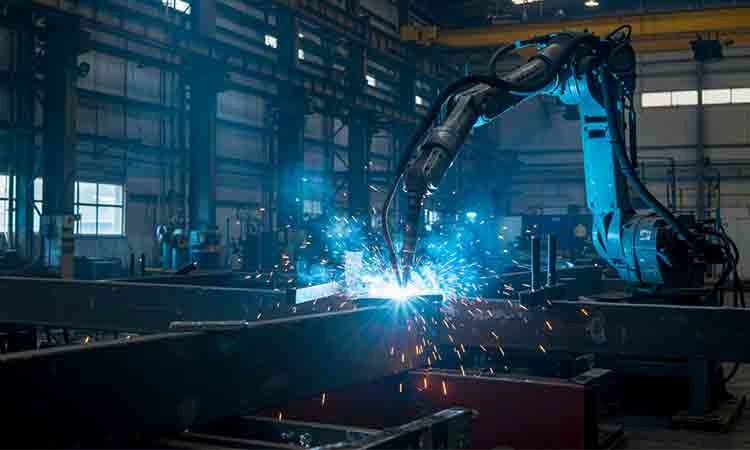
Welding has long been a critical process at the heart of industrial manufacturing, underpinning sectors such as automotive, railways, infrastructure, capital goods, shipbuilding and heavy engineering. In India, where manufacturing is poised for sustained growth driven by initiatives such as Make in India, Atmanirbhar Bharat and large-scale infrastructure development, the demand for high-quality, high-productivity welding has never been greater.
Against this backdrop, robotic welding is emerging as a transformative force—enhancing productivity, consistency and global competitiveness across Indian industry. Once confined largely to automotive OEMs, robotic welding is now gaining traction across a much broader industrial spectrum, fueled by advances in robotics, power sources, sensors and digital technologies.
The Indian Welding Landscape: Challenges and Opportunities
India’s manufacturing ecosystem is characterized by diversity—ranging from large, highly automated plants to MSMEs operating in high-mix, low-volume environments. Traditional manual and semi-automatic welding methods continue to dominate many segments, primarily due to lower upfront investment and abundant labour availability. However, this paradigm is under increasing strain.
Skilled welders are becoming harder to find and retain, quality expectations are rising, and international customers demand consistent weld integrity and traceability. Moreover, welding is a physically demanding and hazardous task, exposing workers to heat, fumes and repetitive strain. These factors are compelling Indian manufacturers to rethink their welding strategies and adopt automation.
Robotic welding addresses many of these challenges by delivering repeatable quality, higher arc-on time and improved workplace safety.
Evolution of Robotic Welding Technologies
Modern robotic welding systems bear little resemblance to their early predecessors.Today’s solutions integrate high-precision industrial robots with advanced welding power sources, intelligent torches, sensors and software platforms.
Robots offer exceptional repeatability and smooth motion control, enabling precise weld bead placement even in complex geometries. Advanced power sources support multiple welding processes such as MIG/MAG, TIG, spot welding, laser welding and hybrid welding, allowing a single robotic cell to handle diverse applications.
In India, the adoption of robotic MIG/MAG welding has grown significantly in automotive components, fabrication, agricultural equipment and railways, while robotic spot welding remains dominant in body-in-white operations.
Expanding the Spectrum of Welding Processes through Robotics
An important dimension of productivity enhancement through robotic welding lies in the adoption of a wider range of welding processes beyond conventional MIG/MAG and spot welding. Indian manufacturers are increasingly deploying robots for high-productivity welding processes such as Submerged Arc Welding (SAW), Plasma Arc Welding (PAW), tandem and twin-wire MIG, and hybrid welding techniques.
Robotic SAW, in particular, is gaining acceptance in heavy fabrication, pressure vessels, wind towers, pipelines and structural components, where deep penetration, high deposition rates and superior weld integrity are essential.
The enclosed arc and granular flux environment of SAW, when combined with robotic precision, delivers exceptionally consistent welds at high travel speeds with minimal spatter and rework. Similarly, robotic plasma welding offers high energy density, narrow heat-affected zones and excellent control, making it suitable for critical applications requiring high weld quality and repeatability.
When these advanced welding processes are integrated with robotic motion control, seam tracking and real-time parameter optimization, they significantly elevate productivity, reduce cycle times and expand the scope of automation in Indian industry—especially in sectors where throughput, metallurgical quality and structural integrity are non-negotiable.
Productivity Gains Through Automation
One of the most compelling benefits of robotic welding is the dramatic improvement in productivity. Robots can operate continuously with minimal breaks, achieving arc-on times of 70–90 percent, compared to significantly lower utilization in manual welding.
Cycle times are reduced through optimized robot paths, synchronized motion and consistent travel speeds. Rework and scrap are minimized due to uniform weld quality, resulting in higher first-pass yield. In high-volume applications, these gains translate into rapid return on investment, often within two to three years. For Indian manufacturers facing intense cost pressures and global competition, such productivity improvements are critical to sustaining margins and scaling operations.
Quality, Consistency and Compliance
Weld quality is a decisive factor in sectors such as automotive, aerospace, railways and pressure vessels, where failure can have serious safety and financial consequences. Robotic welding delivers unparalleled consistency by eliminating human variability.
With precise control over parameters such as voltage, current, wire feed speed and travel angle, robots ensure uniform penetration and bead profile across thousands of parts. Integrated sensors and monitoring systems provide real-time feedback, enabling closed-loop control and immediate correction of deviations.
Digital weld data logging supports traceability and compliance with international standards—an increasingly important requirement for Indian exporters serving global OEMs.
Adaptive Welding with Sensors and AI
One of the key enablers of robotic welding in non-ideal and variable conditions common in Indian fabrication environments is the integration of sensing technologies. Seam tracking sensors, laser scanners and through-arc sensing allow robots to compensate for joint gaps, misalignment and part tolerances.
Artificial intelligence and machine learning are further enhancing adaptability.
AI-driven systems can recognize weld defects, optimize parameters dynamically and learn from historical data to improve performance over time. This capability is particularly valuable in Indian MSMEs, where component variability often limits the feasibility of conventional automation.
Robotic Welding Beyond Automotive
While automotive manufacturing remains the largest adopter, robotic welding is increasingly being deployed in other Indian industries. In railways and metro projects, robots are used for welding coach bodies, bogies and structural components, delivering higher throughput and uniform quality.
In construction equipment, agricultural machinery and heavy fabrication, robotic welding cells handle large frames, booms and chassis components. Even sectors such as shipbuilding, energy equipment and defence manufacturing are exploring robotic and hybrid welding solutions to meet stringent quality and productivity targets.
Addressing the Skill Gap
Contrary to the perception that automation reduces employment, robotic welding is reshaping skill requirements rather than eliminating jobs. As robots take over repetitive welding tasks, the demand for skilled personnel in robot programming, cell integration, maintenance and quality assurance is rising.
In India, forward-looking manufacturers are investing in training programs and collaborating with technology providers, vocational institutes and welding societies to build these capabilities. This shift enhances job quality, improves safety and creates a more future-ready workforce.
Integration with Industry 4.0
Robotic welding systems are increasingly integrated into smart manufacturing frameworks. Connected robots communicate with MES and quality systems, enabling real-time monitoring of productivity, downtime and weld quality metrics.
Digital twins and offline programming tools allow manufacturers to simulate welding processes, optimize layouts and reduce commissioning time. Predictive maintenance based on robot and power source data minimizes unplanned stoppages and extends equipment life.
Such digital integration aligns robotic welding with India’s broader Industry 4.0 ambitions.
Economic and Strategic Implications for India
As India seeks to strengthen its position as a global manufacturing hub, robotic welding plays a strategic role in enhancing productivity, quality and scalability.
Automation enables Indian manufacturers to meet international benchmarks, reduce dependence on manual skills and respond rapidly to growing domestic and export demand.Government initiatives supporting automation, MSME modernization and skill development further accelerate adoption.
The Road Ahead
The future of robotic welding in India is poised for robust growth. Advances in collaborative robots, mobile welding robots, laser and hybrid welding technologies will expand the scope of applications. Lower-cost, modular robotic systems will make automation more accessible to MSMEs.
In the years ahead, robotic welding will evolve from a productivity tool into an intelligent, self-optimizing process at the core of smart factories.
Conclusion.
Robotic welding is no longer a luxury reserved for large automotive plants; it is a strategic necessity for Indian industry striving for productivity, quality and global competitiveness.
By combining precision, consistency and digital intelligence, robotic welding is forging a stronger, more resilient manufacturing future for India.